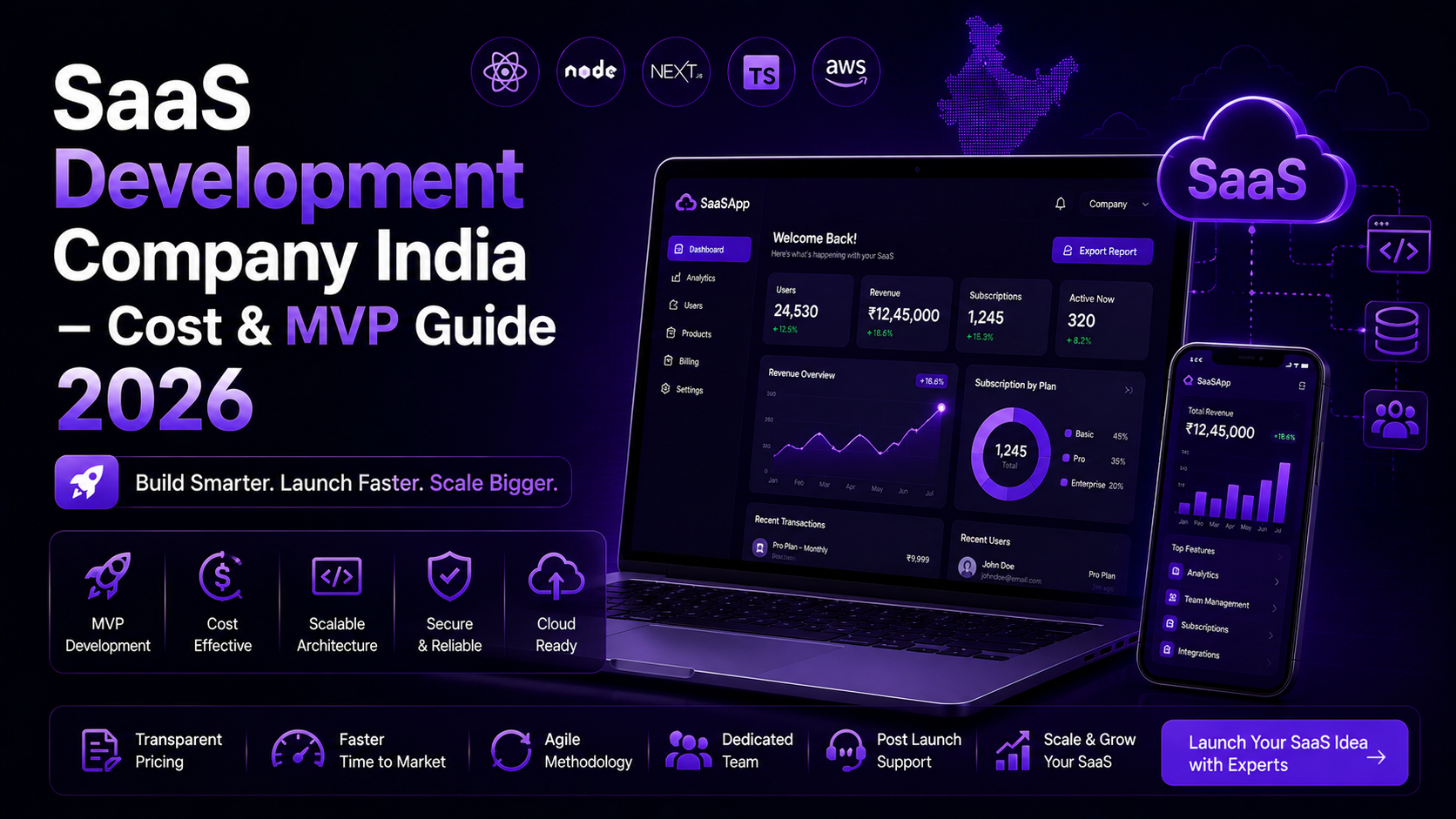
India's SaaS ecosystem is producing world-class products. Zoho, Freshworks, Chargebee, Postman, BrowserStack — all Indian-built SaaS companies competing globally, collectively worth billions. Behind each of them is a product development story that started with a founder, a problem, and a decision about how to build it.
Whether you are exploring saas product development india for the first time or rebuilding an existing tool, that decision — who builds it, how fast, at what cost, on what technology — determines everything. The wrong tech stack at Rs. 5 lakh is a Rs. 50 lakh problem three years later. The right architecture from day one compounds into a product moat.
This is the complete guide to SaaS product development in India in 2026 — for founders, product managers, and business owners evaluating how to build their software product.
Free SaaS product consultation — WhatsApp +91 7009340397
SECTION 1: WHAT IS SAAS DEVELOPMENT?
SaaS (Software as a Service) is software delivered over the internet and accessed via a browser or API — rather than installed on a local computer. The customer subscribes to use the product, typically monthly or annually, without owning the underlying infrastructure.
SaaS development is the process of designing, building, deploying, and maintaining this type of software product.
What makes SaaS different from a regular website or app:
A standard business website is informational and static — it presents content and captures leads. A SaaS product has user accounts, business logic, data processing, workflow automation, integrations with other tools, billing infrastructure, and multi-tenancy — where thousands of separate company accounts operate independently on the same codebase.
The five defining characteristics of a SaaS product:
1. Multi-tenancy — Multiple customers (tenants) share the same application and infrastructure, but their data is completely isolated from each other.
2. Subscription billing — Revenue comes from recurring payments (monthly/annual) rather than one-time purchases. This creates predictable ARR (Annual Recurring Revenue).
3. Self-service onboarding — Customers sign up, configure, and start using the product without human intervention (at least at lower price tiers).
4. Continuous deployment — Features are shipped weekly or monthly, automatically available to all customers. No customer-side installation required.
5. API-first architecture — SaaS products expose API endpoints for integrations with other tools, enabling customers to build workflows around the product.
Examples relevant to the Indian market:
- B2B SaaS: CRM, HRMS, accounting software, project management tools
- Vertical SaaS: Clinic management for hospitals, LMS for coaching institutes, inventory for retailers
- Infrastructure SaaS: Payment gateway APIs, SMS gateways, logistics APIs
- Consumer SaaS: Productivity apps, learning platforms, fitness trackers
Pixocraft Web builds full-stack SaaS products for Indian founders and international businesses. View our services
SECTION 2: SAAS VS TRADITIONAL SOFTWARE
Understanding why SaaS has replaced traditional installed software is essential context for any build decision.
Head-to-Head Comparison
| Factor | Traditional Software | SaaS Product |
|---|---|---|
| Delivery | CD / USB / download | Browser / API |
| Access | Single device | Any device, anywhere |
| Updates | Customer installs patch | Automatic for all users |
| Hosting | Customer's server | Provider's cloud |
| Revenue Model | One-time license | Recurring subscription |
| Scalability | Hardware-limited | Cloud-elastic |
| Maintenance | Customer-managed | Provider-managed |
| Customization | Per-client builds | Config/tenancy model |
| Revenue Predictability | Low | High (ARR) |
| Customer Acquisition Cost | High (sales) | Lower (self-serve) |
| Time to Revenue | Long | Short (free trial → paid) |
Why Indian Businesses Are Choosing SaaS in 2026
GST and compliance complexity has created massive demand for cloud-based accounting, invoicing, and compliance SaaS that updates automatically when regulations change.
Remote work adoption following 2020–2022 normalized browser-based tools across Indian enterprises that previously demanded on-premise software.
SMB digitization — India's 63 million SMBs are adopting their first software tools. They prefer SaaS because there is no IT department to manage servers.
Investor appetite — Indian SaaS startups raised $3.8 billion in 2026. Investors specifically value recurring revenue (ARR) over one-time product sales, making SaaS the preferred model for fundable products.
SECTION 3: MVP VS FULL SAAS PRODUCT
Featured snippet answer: An MVP (Minimum Viable Product) is the smallest version of a SaaS product that delivers the core value proposition to early customers. An MVP should be built first in almost every case — it validates the market before significant capital is committed. Build the full product only after the MVP has paying customers.
What an MVP Is (and Is Not)
An MVP is not a rough, broken, prototype. It is a polished, functional product with deliberately limited scope — doing one thing exceptionally well for a specific user type.
A good MVP:
- Solves one specific problem completely
- Works reliably with zero critical bugs
- Has a clear value exchange (why a user pays or returns)
- Can be shipped in 8 to 16 weeks
- Costs Rs. 5,00,000 to Rs. 15,00,000 to build
A bad MVP:
- Tries to solve too many problems
- Has a long feature wishlist that "will be added later"
- Is so rough that early users cannot evaluate the value
- Takes 12+ months and Rs. 50,00,000 to build
MVP vs Full Product Comparison
| Dimension | MVP | Full SaaS Product |
|---|---|---|
| Scope | Core feature only | Complete feature set |
| User types | 1 (primary persona) | 3–5 (multiple roles) |
| Integrations | 1–2 critical | 10–20+ |
| Payment | Basic (Razorpay / Stripe) | Full billing + plan tiers + invoicing |
| Analytics | Basic usage tracking | Full product analytics + custom reports |
| Admin panel | Minimal | Full admin with user management |
| Mobile | Web-responsive | Native PWA or mobile app |
| SLA / Uptime | Best effort | 99.9% with monitoring |
| Development time | 8–16 weeks | 6–18 months |
| Cost | Rs. 5L – Rs. 15L | Rs. 20L – Rs. 1.5Cr+ |
| Goal | Validate market | Scale and retain |
The MVP Decision Framework
| Situation | Recommended Path |
|---|---|
| Pre-revenue, no paying customers | Build MVP first |
| Have paying customers, need more features | Expand current MVP |
| Have raised Seed funding (Rs. 1Cr+) | Full product with 12-month roadmap |
| Replacing existing internal software | Start with feature parity MVP |
| Entering competitive market with established players | MVP with one unique differentiating feature |
| Building for a single enterprise client | Custom build (not SaaS architecture) |
The founder question to answer before building: "If I had 10 paying customers using this product tomorrow, what is the one feature they absolutely cannot live without?" Build only that feature first.
SECTION 4: MULTI-TENANT ARCHITECTURE EXPLAINED (MULTI TENANT SAAS)
Featured snippet answer: Multi-tenancy is an architecture where a single deployment of an application serves multiple separate customers (tenants), with each customer's data completely isolated from others. It is the defining architectural characteristic of SaaS products and enables one codebase to serve thousands of customers at a fraction of the infrastructure cost of separate deployments.
The Three Multi-Tenancy Models
Model 1 — Database-per-tenant (Siloed) Each customer gets their own separate database. Maximum data isolation. Easiest to customize per client. Most expensive to scale — 100 customers = 100 databases.
Best for: Enterprise SaaS with strict data compliance requirements (healthcare, legal, financial), or when customers require dedicated database locations for regulatory reasons.
Infrastructure cost: High. Maintenance complexity: High.
Model 2 — Shared database, separate schemas All customers share one database server but each gets a separate schema (namespace). Good isolation without the overhead of separate database servers.
Best for: Mid-market SaaS with 100–1,000 tenants needing reasonable isolation without excessive infrastructure cost.
Infrastructure cost: Medium. Maintenance complexity: Medium.
Model 3 — Shared database, shared schema with tenant_id
All customers share one database and one schema. Every table has a tenant_id column that filters data per customer. Cheapest to scale — one database serves unlimited tenants.
Best for: Consumer SaaS or high-volume B2B SaaS where the customer base is large and data compliance requirements are standard.
Infrastructure cost: Lowest. Maintenance complexity: Low (but requires careful query design to prevent data leakage).
Multi-Tenancy Implementation Checklist
For any SaaS product, verify these before launch:
- Every database query is filtered by
tenant_idor scoped to tenant schema - Authentication tokens cannot be used across tenants
- File uploads are stored in tenant-specific storage paths (S3 prefix:
tenant_id/) - API rate limiting is enforced per tenant, not globally
- Background jobs cannot accidentally process data from the wrong tenant
- Audit logs record tenant context for every action
- Admin panel has separate authentication from tenant user portal
Pixocraft Web implements multi-tenant architecture as standard on all SaaS builds. Contact us for a SaaS architecture consultation
SECTION 5: SAAS TECH STACK COMPARISON
The technology stack for a SaaS product determines performance, scalability, developer availability, and long-term maintenance cost. Here is the 2026 comparison for Indian SaaS development.
Frontend Framework Comparison
| Framework | Performance | SEO | Developer Pool | SaaS Suitability | Learning Curve |
|---|---|---|---|---|---|
| React (standalone) | Excellent | Good (with SSR) | Very Large | ★★★★★ | Medium |
| Next.js (React SSR) | Excellent | Excellent | Large | ★★★★★ | Medium |
| Vue.js | Excellent | Good | Medium | ★★★★☆ | Low |
| Angular | Good | Good | Medium | ★★★★☆ | High |
| Svelte | Excellent | Good | Small | ★★★☆☆ | Low |
Recommendation: React with Next.js for the marketing/landing pages + React standalone for the SaaS dashboard. This gives excellent SEO for customer acquisition pages and optimal performance for the authenticated product interface.
SECTION 6: REACT VS NEXT.JS VS ANGULAR FOR SAAS DASHBOARDS
React (Standalone)
Best suited for the authenticated SaaS dashboard — where SEO is irrelevant and real-time UI interaction is the priority. React's component model and vast ecosystem (React Query, Zustand, Recharts, Tanstack Table) make it ideal for building data-dense dashboards, analytics views, and workflow builders.
Use React for: Internal dashboards, admin panels, customer portals, data visualization, real-time collaboration tools.
Not ideal for: Public-facing marketing pages where SEO matters.
Next.js
The best choice for SaaS marketing pages, documentation, blog, and any SEO-indexed pages. Next.js server-side rendering ensures Google can crawl and index content fully. App Router (Next.js 14+) enables streaming, partial rendering, and React Server Components — dramatically reducing TTFB.
Use Next.js for: Landing pages, pricing pages, blog, documentation, help center, SEO-driven content. Also suitable as a unified framework serving both marketing pages and the dashboard.
2026 adoption: Next.js is the dominant choice for Indian SaaS product teams building full-stack applications. Vercel deployment with Edge Functions provides near-zero configuration global CDN.
Angular
A full-featured opinionated framework with built-in dependency injection, routing, and form validation. Preferred in large enterprise teams because the strict structure enforces consistency across 20+ developers.
Use Angular for: Enterprise SaaS with 15+ frontend developers, complex forms-heavy applications (ERP, HRMS, compliance tools).
Not ideal for: Early-stage startups — Angular's learning curve and boilerplate overhead slows MVP development significantly.
SECTION 7: NODE.JS VS DJANGO VS LARAVEL FOR SAAS BACKENDS
| Factor | Node.js (Express/NestJS) | Django (Python) | Laravel (PHP) |
|---|---|---|---|
| Language | JavaScript / TypeScript | Python | PHP |
| Performance (API) | Excellent (async I/O) | Good | Good |
| AI/ML Integration | Good (via APIs) | Excellent (native Python) | Limited |
| Developer Cost India | Medium | Medium | Lower |
| Enterprise Adoption | High | High | Medium |
| Real-time Features | Excellent (WebSocket) | Good (Channels) | Good (Pusher) |
| ORM | Prisma / Drizzle / TypeORM | Django ORM | Eloquent |
| REST API Speed | Fastest | Good | Good |
| Learning Curve | Low-Medium | Medium | Low |
| Best For | Full-stack JS, real-time | Data-heavy, AI-integrated | Rapid CRUD SaaS |
Pixocraft Web's Recommended SaaS Stack (2026)
| Layer | Technology | Reason |
|---|---|---|
| Frontend (Marketing) | Next.js 14 + Tailwind CSS | Best SEO + performance |
| Frontend (Dashboard) | React 18 + Shadcn/UI | Best component ecosystem |
| Backend API | Node.js + NestJS | Full TypeScript, scalable |
| Database (Primary) | PostgreSQL | ACID compliance, JSON support |
| Cache | Redis | Session storage, rate limiting |
| File Storage | AWS S3 / Cloudflare R2 | Scalable, cheap, CDN-ready |
| Background Jobs | Bull (Redis-based) | Reliable queue processing |
| Resend / AWS SES | Deliverability + cost | |
| Payments | Razorpay (India) + Stripe (International) | Full coverage |
| Monitoring | Sentry + Axiom | Error tracking + logs |
| Deployment | Vercel (frontend) + Hetzner/Railway (backend) | Performance + cost |
SECTION 8: SAAS DEVELOPMENT COST INDIA — 2026
Featured snippet answer (saas development cost india): SaaS development cost in India ranges from Rs. 5,00,000 to Rs. 15,00,000 for an MVP, Rs. 15,00,000 to Rs. 50,00,000 for a mid-market SaaS product, and Rs. 50,00,000 to Rs. 2,00,00,000+ for an enterprise SaaS platform. The cost depends on the number of features, user roles, integrations, AI capabilities, and team composition.
Cost Breakdown by Product Tier
| Product Tier | Description | Development Cost | Timeline |
|---|---|---|---|
| MVP | Core feature, 1–2 user roles, basic integrations | Rs. 5L – Rs. 15L | 8–16 weeks |
| Startup SaaS | 3–5 user roles, 5–10 integrations, billing | Rs. 15L – Rs. 35L | 4–8 months |
| Growth SaaS | Full feature set, analytics, mobile, 20+ integrations | Rs. 35L – Rs. 80L | 8–14 months |
| Enterprise SaaS | White-labeling, SSO, compliance, custom reporting | Rs. 80L – Rs. 2Cr+ | 12–24 months |
Module-by-Module Cost Breakdown
| Feature Module | Development Cost |
|---|---|
| Authentication (email/password + OAuth) | Rs. 40,000 – Rs. 80,000 |
| Multi-tenancy architecture | Rs. 60,000 – Rs. 1,20,000 |
| Subscription billing (Razorpay / Stripe) | Rs. 80,000 – Rs. 1,50,000 |
| Role-based access control | Rs. 40,000 – Rs. 80,000 |
| Dashboard and analytics | Rs. 80,000 – Rs. 2,00,000 |
| Email notification system | Rs. 30,000 – Rs. 60,000 |
| In-app notification system | Rs. 40,000 – Rs. 80,000 |
| File upload and storage | Rs. 30,000 – Rs. 60,000 |
| API and webhook system | Rs. 60,000 – Rs. 1,20,000 |
| Search and filtering | Rs. 40,000 – Rs. 80,000 |
| Admin super-panel | Rs. 80,000 – Rs. 1,50,000 |
| AI feature integration | Rs. 1,00,000 – Rs. 3,00,000 |
| Mobile-responsive PWA | Rs. 60,000 – Rs. 1,20,000 |
| SSO (SAML/OIDC) | Rs. 1,00,000 – Rs. 2,00,000 |
| Audit logs and compliance | Rs. 60,000 – Rs. 1,20,000 |
Team Composition and Monthly Cost (India)
| Role | Freelancer (Monthly) | Agency (Included in project) |
|---|---|---|
| Frontend Developer (React/Next.js) | Rs. 60,000 – Rs. 1,50,000 | Included |
| Backend Developer (Node.js) | Rs. 60,000 – Rs. 1,50,000 | Included |
| UI/UX Designer | Rs. 40,000 – Rs. 1,00,000 | Included |
| DevOps / Cloud Engineer | Rs. 80,000 – Rs. 2,00,000 | Included |
| Product Manager | Rs. 80,000 – Rs. 2,00,000 | Included |
| QA Engineer | Rs. 30,000 – Rs. 80,000 | Included |
Agency vs freelance team: Building a SaaS product with a freelance team costs less per person but requires significant founder time managing coordination, code review, integration, and QA. Agencies provide unified delivery with a defined scope and timeline — typically 30–50% more expensive per hour but faster to production with less founder overhead.
Get a fixed SaaS development estimate — WhatsApp +91 7009340397
SECTION 9: MVP DEVELOPMENT COST INDIA — BREAKDOWN BY PRODUCT TYPE
As an mvp development company india trusts, Pixocraft Web has delivered MVP products across CRM, healthcare, real estate, logistics, and education categories. The cost varies significantly by product type.
Different SaaS categories have different MVP scopes and therefore different costs:
| SaaS Category | Core MVP Feature | MVP Cost | Timeline |
|---|---|---|---|
| CRM / Pipeline | Contact management + deal tracking | Rs. 5L – Rs. 8L | 8–10 weeks |
| HRMS | Attendance + leave + payroll basics | Rs. 7L – Rs. 12L | 10–14 weeks |
| Invoicing / Accounting | Create invoices, track payments | Rs. 4L – Rs. 7L | 6–10 weeks |
| Project Management | Tasks, assignments, progress tracking | Rs. 6L – Rs. 10L | 8–12 weeks |
| LMS / EdTech | Course delivery + student progress | Rs. 8L – Rs. 14L | 10–16 weeks |
| E-commerce SaaS | Multi-store platform + product catalog | Rs. 10L – Rs. 18L | 12–18 weeks |
| Healthcare / Clinic | Appointment booking + patient records | Rs. 7L – Rs. 12L | 10–14 weeks |
| Analytics / BI Tool | Data ingestion + basic dashboard | Rs. 12L – Rs. 20L | 14–18 weeks |
| Marketplace | Buyer + seller profiles + listings | Rs. 10L – Rs. 18L | 12–18 weeks |
What Increases MVP Cost
- Multiple user roles — Every additional user type (admin, manager, staff, client, viewer) roughly doubles interface complexity
- Real-time features — Live notifications, collaborative editing, real-time analytics require WebSocket infrastructure
- Complex billing — Multiple plan tiers, proration, metered billing, and Indian GST-compliant invoicing add 2–4 weeks
- Third-party integrations — Each API integration (Razorpay, WhatsApp Business, Tally, Zoho) adds Rs. 15,000 to Rs. 40,000
- Mobile requirements — Full PWA adds 20–30% to frontend cost; React Native adds 40–60%
SECTION 10: SAAS DEVELOPMENT TIMELINE
Featured snippet answer: A SaaS MVP takes 8 to 16 weeks to build. A full-featured SaaS product takes 6 to 18 months depending on scope. The critical path is always authentication, core feature, and billing — everything else can be shipped in subsequent sprints.
Phase-by-Phase Timeline
| Phase | Activities | Duration |
|---|---|---|
| Discovery & Architecture | Requirements, user stories, system design, data model, tech stack decision | 1–2 weeks |
| UI/UX Design | Wireframes, user flow, component library, design system, prototype review | 1–3 weeks |
| Infrastructure Setup | Cloud environment, CI/CD pipeline, database, domain, staging environment | 1 week |
| Authentication & Tenancy | Auth system, multi-tenancy, role-based access, email verification | 2–3 weeks |
| Core Feature Development | Primary value feature — the thing the product does | 4–8 weeks |
| Billing Integration | Subscription management, Razorpay/Stripe, plan tiers, invoicing | 1–2 weeks |
| Dashboard & Analytics | User dashboard, basic reporting, activity feeds | 2–3 weeks |
| Integrations | Third-party APIs, webhooks, email notifications | 1–3 weeks |
| Testing & QA | Functional testing, security testing, performance testing, UAT | 1–2 weeks |
| Staging & Beta | Beta customer onboarding, feedback collection, critical fixes | 2–4 weeks |
| Production Launch | Domain, SSL, monitoring, SEO basics, launch | 1 week |
| MVP Total | 8–16 weeks |
Sprint Structure for SaaS Development
Pixocraft Web delivers SaaS projects in 2-week sprints with:
- Sprint planning at start (scope agreement)
- Mid-sprint demo (progress review)
- Sprint review with client (delivery + feedback)
- Deployed to staging at end of every sprint (always a working product)
This means by week 4, the founder always has a working version — authentication, core feature, and a navigable interface — even if billing and secondary features are not complete.
SECTION 11: COMMON SAAS STARTUP MISTAKES
These are the mistakes that cost Indian SaaS founders the most time and money in 2026. Each has been observed across multiple real projects.
Mistake 1 — Building for a future customer instead of a current one The most common and most expensive mistake. Building a feature set designed for an imagined large customer while no paying customer currently exists. The result is a product that does too much for the people who need it most (early adopters who want simplicity) and not enough for enterprise customers (who need specific integrations you haven't built yet).
Mistake 2 — Perfecting the design before validating the feature Spending 6 weeks on UI polish before a single customer has validated the underlying feature is backwards. Ship a functional prototype, get feedback, then polish. The design language can always be upgraded. A feature nobody uses cannot be unbuilt.
Mistake 3 — Choosing the wrong billing architecture Implementing billing with simple monthly flat fees and discovering 6 months later that customers need usage-based pricing, annual billing, per-seat pricing, and proration. Retrofit billing is one of the most expensive technical debts in SaaS. Plan the full billing model before writing the first line of payment code.
Mistake 4 — No observability from day one Launching without error tracking (Sentry), application performance monitoring, and logging means every production issue requires hours of manual debugging. Instrument your product for observability before the first customer, not after the first outage.
Mistake 5 — Building SSO before you have enterprise customers SAML/OIDC Single Sign-On is an enterprise requirement. It takes 3–4 weeks to build. Building it at MVP stage is wasted effort for 90% of early-stage SaaS companies. Add it when the first enterprise prospect makes it a procurement requirement.
Mistake 6 — Single-region database for a global product Deploying your PostgreSQL database in a single AWS region (ap-south-1 Mumbai, for example) works fine for Indian customers. For customers in the US or Europe, the latency of every API call is unacceptable. Multi-region is not needed for MVP — but the architecture must support it when the time comes.
Mistake 7 — Ignoring GST compliance in Indian billing Every B2B SaaS operating in India must issue GST-compliant invoices — with GSTIN display, HSN/SAC codes, and correct IGST/CGST/SGST breakdowns. Building billing without GST compliance means manual invoicing for every transaction. Build it right the first time.
Mistake 8 — Onboarding that requires a sales call If a new user cannot go from signup to experiencing value within 10 minutes without talking to anyone, the product's growth ceiling is determined by the sales team's capacity. Build a self-serve onboarding flow. Record Loom videos. Build in-app tooltips. Remove friction.
Mistake 9 — No tenant data isolation testing Assuming multi-tenancy is correct without testing is a production catastrophe waiting to happen. In every SaaS project, before launch, run explicit cross-tenant access tests: can User A from Company X ever see data belonging to Company Y? The test should fail visibly, not silently.
Mistake 10 — Overcomplicating the free trial 14-day free trials with credit card required, feature limits, and no onboarding guidance convert poorly. The best-converting SaaS trials in 2026 are: free forever for up to N users/records, credit card not required, full feature access, and a single value-delivery moment in the first session.
SECTION 12: AI FEATURES IN MODERN SAAS PRODUCTS (2026)
AI is no longer a differentiator in SaaS — in most categories, it is table stakes. Every SaaS product being built in 2026 should have an answer to the question "where does AI make this product meaningfully better?"
The 8 AI Layers for SaaS Products
Layer 1 — Smart Search Replace keyword search with semantic search using vector embeddings. Users find relevant records by meaning, not by exact word match. Implementation: OpenAI embeddings + pgvector (PostgreSQL extension). Cost: Rs. 50,000 – Rs. 1,00,000.
Layer 2 — Content Generation Auto-generate first drafts of documents, emails, reports, or messages from structured data. A CRM can draft follow-up emails from deal context. An HRMS can draft job descriptions from role templates. Implementation: GPT-4 API with structured prompts. Cost: Rs. 40,000 – Rs. 80,000.
Layer 3 — Predictive Analytics Forecast outcomes from historical data. Sales forecast, churn prediction, inventory demand, staffing needs. Implementation: Time-series models or GPT-4 with function calling on aggregated data. Cost: Rs. 80,000 – Rs. 2,00,000.
Layer 4 — Automated Classification Automatically tag, categorize, and route incoming items (support tickets, leads, documents) without manual intervention. Implementation: OpenAI fine-tuned classifier. Cost: Rs. 50,000 – Rs. 1,20,000.
Layer 5 — Natural Language Interface Let users ask questions about their data in plain language: "What are my top 5 clients by revenue this quarter?" Return structured answers. Implementation: GPT-4 + text-to-SQL or function calling. Cost: Rs. 80,000 – Rs. 1,50,000.
Layer 6 — Anomaly Detection Alert users when data behaves unusually: expense spike, traffic drop, team velocity change. Implementation: Statistical models or LLM analysis of time-series data. Cost: Rs. 60,000 – Rs. 1,20,000.
Layer 7 — Workflow Suggestions AI observes user behavior and suggests workflow improvements: "You always move leads to 'Follow-up' after a demo — should I automate this?" Implementation: Behavioral pattern analysis + LLM suggestion engine. Cost: Rs. 1,00,000 – Rs. 2,00,000.
Layer 8 — AI-Powered Onboarding An onboarding assistant that guides new users through setup based on their role and goals — replacing static tooltip sequences with a conversational AI guide. Implementation: RAG (Retrieval Augmented Generation) over product documentation. Cost: Rs. 80,000 – Rs. 1,50,000.
The AI Stack for Indian SaaS Products
| Component | Provider | Cost Model |
|---|---|---|
| LLM API | OpenAI GPT-4o | Rs. 5–15 per 1000 tokens |
| Embeddings | OpenAI text-embedding-3-small | Rs. 0.02 per 1000 tokens |
| Vector Database | pgvector (free in PostgreSQL) | Included in DB cost |
| AI Orchestration | LangChain (open-source) | Free |
| Speech-to-Text | OpenAI Whisper API | Rs. 24 per hour |
| Image Analysis | GPT-4o Vision | Per-token |
SECTION 13: SAAS SECURITY AND COMPLIANCE
Security is not optional at any stage of SaaS development. A single data breach destroys customer trust in a market where trust is the primary barrier to adoption.
Security Baseline for Every SaaS Product
Authentication security:
- Passwords hashed with bcrypt (minimum 12 rounds) — never stored in plaintext
- JWT tokens with short expiry (15 minutes access token, 7 days refresh token)
- Refresh token rotation — each use invalidates the previous refresh token
- Account lockout after 5 failed login attempts
- Email verification required before account activation
Data security:
- HTTPS enforced on all endpoints (HTTP Strict Transport Security header)
- Sensitive fields encrypted at rest (AES-256) — health data, financial data, personal identifiers
- Database connection strings in environment variables, never in code
- S3 presigned URLs for file access — no public bucket policies
API security:
- Rate limiting per user and per IP (100 requests/minute standard, lower for auth endpoints)
- Input validation and sanitization on every API parameter
- SQL injection prevention via parameterized queries (never string concatenation)
- CORS policy restricted to known origins
Infrastructure security:
- VPC configuration — database not publicly accessible
- Secrets managed via AWS Secrets Manager or environment variables (never .env in repository)
- Automated dependency vulnerability scanning (npm audit, Snyk)
- Regular automated backups with tested restore procedure
Indian Compliance Requirements
DPDP Act (Digital Personal Data Protection Act, 2023) India's primary data privacy law. Applies to any SaaS product collecting or processing personal data of Indian residents.
Key requirements:
- Consent before collecting personal data
- Clear privacy notice explaining data use
- Data principal rights (access, correction, erasure)
- Data retention policies (retain only as long as necessary)
- Breach notification to PDPB within 72 hours
- Data localization for certain sensitive categories
GST Compliance SaaS revenue is taxable under GST (18% GST on software services). B2B invoices must include customer GSTIN, supplier GSTIN, HSN code 998314 (for SaaS), and correct IGST/CGST/SGST breakdown.
Startup India Recognition DPIIT-recognized startups receive income tax exemptions and simplified compliance for the first 3 years. Early-stage SaaS companies should apply for recognition before revenue begins.
SECTION 14: SAAS MONETIZATION MODELS
How you charge determines your product's architecture. Build the billing system that supports your monetization model from day one.
The 6 SaaS Pricing Models and When to Use Each
| Model | Structure | Best For | Indian Example |
|---|---|---|---|
| Per-seat (per-user) | Rs. X per user per month | Team tools, collaboration | CRM, project management |
| Usage-based (metered) | Rs. X per 1000 API calls / messages / transactions | Infra, communication tools | SMS gateway, payment API |
| Flat-rate (subscription) | Fixed Rs. per month regardless of usage | Simple tools, small teams | Invoicing, scheduling |
| Tiered pricing | 3–5 tiers with feature gates | Most B2B SaaS | Starter / Professional / Enterprise |
| Freemium | Free tier + paid upgrade | High-volume consumer/SMB | Project tools, storage |
| Usage + seat hybrid | Per-user base + metered add-ons | Complex enterprise | CRM + email credits |
Pricing Architecture Implementation
Each model requires different billing infrastructure:
Per-seat: Count active users at billing date. Support pro-ration for mid-cycle additions.
Usage-based: Instrument every billable action in the application. Store usage events in a metering table. Aggregate at billing cycle.
Tiered: Feature flags per plan tier. Gate-check on every feature access. Upgrade prompts at feature walls.
Freemium: Generous free tier with hard caps at the point of value (storage limit, team members, API calls). Upgrade triggered at cap.
SaaS Pricing for Indian Market
Indian B2B SaaS pricing in 2026 benchmarks:
| Tier | Monthly Price | Target Segment |
|---|---|---|
| Starter | Rs. 999 – Rs. 2,999 | Solopreneurs, micro-businesses |
| Professional | Rs. 4,999 – Rs. 12,999 | SMBs, teams of 5–20 |
| Business | Rs. 14,999 – Rs. 40,000 | Mid-market companies |
| Enterprise | Rs. 50,000 – Rs. 2,00,000+ | Large enterprises (custom) |
Critical insight: Indian SMBs are significantly price-sensitive compared to US counterparts. Indian SaaS products price at 20–40% of equivalent US pricing and compensate with volume. Freemium with a clear upgrade path is the most effective GTM for Indian SMB SaaS.
SECTION 15: B2B SAAS EXAMPLES — INDIAN MARKET OPPORTUNITIES
b2b saas development india is one of the fastest-growing categories in Indian technology, with ARR-positive companies emerging in verticals ranging from logistics to healthcare. These are the underserved opportunities in 2026:
Real Estate SaaS Builder CRM with inventory management, booking workflows, payment schedules, RERA compliance, and broker commission management. Current tools are either too simple (Excel) or too complex (Salesforce). Market: 10,000+ Indian builders. Pricing potential: Rs. 5,000 – Rs. 25,000/month.
Logistics SaaS Route optimization, consignment tracking, POD (Proof of Delivery) collection, GST e-way bill generation, and client portal — integrated into one platform for SMB logistics companies. Most current tools require separate software for each function. Market: India's 18,000+ transport companies.
Restaurant Management SaaS Table management, kitchen display, inventory, staff scheduling, Zomato/Swiggy order aggregation, and GST billing in one platform for multi-location restaurants. Existing tools (Petpooja, Posist) are strong but leave gaps in analytics and integrations.
Education Management SaaS Coaching institute management covering admissions, batch management, attendance, online classes, fee collection, and parent communication — designed specifically for the structure of Indian coaching centers (which differs fundamentally from Western LMS tools).
Healthcare SaaS Clinic management covering appointments, EMR, billing, ABDM (Ayushman Bharat Digital Mission) compliance, insurance claim tracking, and WhatsApp patient communication — built to Indian regulatory requirements from the ground up.
Read our healthcare website development guide for more context on the healthcare sector.
SECTION 16: BUILD VS BUY ANALYSIS FOR SAAS FOUNDERS
custom saas development india means building a product tailored precisely to a specific market — not configuring a white-label tool or adapting a generic platform. This is the decision every founder must make before writing the first line of code: what do you build custom vs what do you buy/integrate?
The Rule: Never Build What Exists as a Commodity
| Function | Build? | Buy Instead |
|---|---|---|
| Authentication | ❌ Never | Auth0, Clerk, Supabase Auth |
| Email delivery | ❌ Never | Resend, AWS SES, SendGrid |
| SMS gateway | ❌ Never | MSG91, Twilio, 2Factor |
| Payment processing | ❌ Never | Razorpay, Stripe |
| File storage | ❌ Never | AWS S3, Cloudflare R2 |
| Video conferencing | ❌ Never | Daily.co API, Zoom SDK |
| PDF generation | ❌ Rarely | PDFMonkey, Puppeteer (self-hosted) |
| Search | ⚠ Depends | Algolia, Meilisearch, pgvector |
| AI / LLM | ⚠ Depends | OpenAI API (most cases) |
| Core product logic | ✅ Always | This is your moat |
| Domain-specific workflows | ✅ Always | No off-the-shelf equivalent |
| Proprietary data model | ✅ Always | No vendor can understand your domain |
The 3-Year TCO Comparison
| Approach | Year 1 | Year 2 | Year 3 | Notes |
|---|---|---|---|---|
| Custom SaaS build | Rs. 20L (build) + Rs. 3L (ops) | Rs. 5L (features) | Rs. 5L (features) | Own the asset |
| Off-the-shelf subscription | Rs. 2L–Rs. 6L | Rs. 3L–Rs. 8L | Rs. 5L–Rs. 12L | Grows with usage, limited customization |
| White-label SaaS | Rs. 2L setup + Rs. 3L/year | Rs. 3L | Rs. 3L | No product ownership, brand dilution |
The custom SaaS break-even: A custom SaaS build becomes cost-equal to a subscription SaaS at roughly Year 2 and becomes the cheaper option from Year 3 — while also being fully customizable, owned, and saleable as a product asset.
SECTION 17: FREQUENTLY ASKED QUESTIONS
How much does SaaS development cost in India? SaaS development in India costs Rs. 5,00,000 to Rs. 15,00,000 for an MVP (8–16 weeks), Rs. 15,00,000 to Rs. 50,00,000 for a full startup SaaS product (4–8 months), and Rs. 50,00,000 to Rs. 2,00,00,000+ for an enterprise SaaS platform (12–24 months). Costs depend on features, user roles, AI integrations, and compliance requirements.
How long does it take to build a SaaS product in India? An MVP takes 8 to 16 weeks. A full-featured startup SaaS product takes 4 to 8 months. An enterprise SaaS platform takes 12 to 24 months. Pixocraft Web delivers all projects in 2-week sprints with a working staging version deployed at the end of every sprint.
What is multi-tenant SaaS architecture? Multi-tenancy is when a single application deployment serves multiple separate customers (tenants), with each customer's data completely isolated. It is the defining architecture of SaaS products and enables one codebase to serve thousands of customers simultaneously, dramatically reducing per-customer infrastructure cost.
Should I build an MVP or a full product first? Always build an MVP first unless you have Seed funding and established paying customers validating the full feature set. An MVP validates market fit before significant capital is committed. The most expensive mistake in SaaS is building a full product for a market that does not exist.
What is the best tech stack for SaaS development in India? The standard production SaaS stack in India in 2026 is: Next.js (marketing pages), React (dashboard), Node.js/NestJS (backend API), PostgreSQL (primary database), Redis (caching/queues), Razorpay (India payments), Stripe (international), AWS S3 (storage), and Vercel/Hetzner (hosting). This stack has the largest developer pool, best performance characteristics, and lowest long-term maintenance cost.
Can I build a SaaS product without a technical co-founder? Yes. Working with a dedicated SaaS development agency is a valid alternative to a technical co-founder for early-stage founders. The trade-off: agency builds cost more in the short term than a co-founder's equity, but the agency delivers on a fixed timeline without the risk of co-founder departure or misaligned incentives.
What is B2B SaaS development? B2B SaaS (Business-to-Business Software as a Service) is software sold to companies rather than individual consumers. B2B SaaS is characterized by longer sales cycles, higher average contract value (ACV), multiple user roles within each customer account, and enterprise feature requirements (SSO, audit logs, compliance, admin controls). Indian B2B SaaS is among the world's fastest-growing software categories.
How do I monetize a SaaS product in India? The most effective SaaS monetization for India is a freemium model with per-seat or tiered pricing. Free tier captures SMB users who later upgrade as their team grows. Tiered pricing gates advanced features (analytics, API access, custom integrations) behind Professional/Business plans. GST-compliant invoicing must be implemented from day one for B2B billing.
What security certifications do Indian SaaS products need? Most early-stage SaaS products do not need formal certifications at launch. However, SOC 2 Type II becomes a procurement requirement when selling to mid-market and enterprise customers (typically requested after Rs. 50 lakh ARR). ISO 27001 is required for some healthcare and government contracts. DPDP Act compliance is mandatory from day one for any product handling Indian personal data.
What is custom SaaS development? Custom SaaS development means building a SaaS product from scratch specifically for your use case — rather than using a white-label SaaS platform or configuring an off-the-shelf tool. Custom SaaS development gives full ownership of the codebase, complete control over features and architecture, and the ability to build proprietary workflows that no off-the-shelf product can replicate.
How much does MVP development cost in India? MVP development in India costs Rs. 5,00,000 to Rs. 15,00,000 depending on the product category and feature scope. A simple single-feature MVP (invoicing tool, booking system, basic CRM) costs Rs. 4–8 lakh. A more complex MVP with multiple user roles, payment integration, and 2–3 API integrations costs Rs. 10–15 lakh.
What is the difference between SaaS and a website? A website presents information and captures leads. A SaaS product has user authentication, data storage per user/tenant, business logic, workflow automation, subscription billing, and continuous delivery of new features. A SaaS product is a software business delivered over the internet; a website is a digital presence for any type of business.
Can Pixocraft Web build a SaaS product from scratch? Yes. Pixocraft Web builds full-stack SaaS products in React, Next.js, and Node.js — from discovery and architecture through MVP launch and ongoing feature development. We have delivered SaaS products in the CRM, healthcare, real estate, logistics, and education categories. Contact us for a free SaaS consultation.
What hosting infrastructure is recommended for Indian SaaS? For Indian SaaS products, the recommended infrastructure is: AWS ap-south-1 (Mumbai) or Hetzner (Germany/Finland) for the backend server, Vercel for the Next.js frontend (global CDN), AWS S3 or Cloudflare R2 for file storage, and AWS RDS PostgreSQL for the database. Hetzner + Railway offers 60–70% lower cost than AWS with comparable performance for early-stage products.
Do I need a mobile app for my SaaS product? Most SaaS products do not need a native iOS/Android app at MVP stage. A Progressive Web App (PWA) — a React web application configured for mobile — provides 85% of the user experience of a native app without the App Store approval process or additional development cost. Native apps are worth building when the product requires camera, notifications, or offline-first functionality.
How is SaaS development different from custom software development? SaaS is specifically built for multi-tenancy (multiple separate customers), self-service onboarding, subscription billing, and continuous deployment. Custom software is typically built for a single client with specific requirements, delivered once, and maintained privately. SaaS development requires additional architecture decisions (tenancy model, billing system, API design) that custom software does not.
What makes India a good location for SaaS development? India has the world's second-largest developer pool, strong English fluency in the tech workforce, competitive pricing (30–60% below US or European development rates), time zone overlap with both the US (morning hours) and Europe (full overlap), and a growing ecosystem of SaaS-experienced developers from companies like Freshworks, Zoho, and Razorpay. Building with an Indian SaaS agency provides access to this talent pool at significant cost efficiency.
How do I find a good SaaS development company in India? Evaluate a SaaS development company on: live SaaS products they have built (not just websites), their ability to articulate multi-tenancy architecture, their experience with subscription billing implementation, their code quality standards (ask for a GitHub link or code sample), and their project delivery process (ask how they handle scope changes and how often clients see working demos).
What is the minimum team size for building a SaaS product? A minimum viable SaaS development team is 3 people: one full-stack developer, one frontend specialist, and one product/UX designer. A production-quality team with fast delivery is 5–7 people: frontend developer, backend developer, DevOps engineer, QA engineer, UI/UX designer, and product manager.
What ongoing costs should I budget for after SaaS launch? Post-launch monthly costs for an Indian SaaS product: cloud infrastructure Rs. 5,000 – Rs. 30,000/month, third-party SaaS tools (auth, email, monitoring) Rs. 3,000 – Rs. 15,000/month, AI API costs Rs. 2,000 – Rs. 20,000/month, and ongoing development (1–2 sprints/month for features and maintenance) Rs. 50,000 – Rs. 2,00,000/month.
How does Pixocraft Web price SaaS development projects? Pixocraft Web prices SaaS projects as fixed-scope, fixed-price engagements with a defined sprint plan delivered over 2-week cycles. Every project begins with a 1-week discovery phase that produces a detailed technical specification, architecture diagram, and sprint plan — before development cost is finalized. WhatsApp +91 7009340397 to start a discovery conversation.
BUILD YOUR SAAS PRODUCT WITH PIXOCRAFT WEB
Pixocraft Web is a saas development company india trusts — delivering products for founders and business owners to build their SaaS products from zero to launch.
Every SaaS product we build includes:
- Proven tech stack — React, Next.js, Node.js, PostgreSQL, Redis
- Multi-tenant architecture built correctly from day one
- Subscription billing — Razorpay for India, Stripe for international, GST-compliant invoices
- AI-ready infrastructure — OpenAI API integration available from Sprint 1
- Fixed sprint delivery — working staging version every 2 weeks
- Full source code ownership — you own every line of code we write
- Post-launch support — WhatsApp-response SLA for production issues
Start Your SaaS Project in 3 Steps
Step 1 — WhatsApp +91 7009340397 with your product idea (2–3 sentences is enough)
Step 2 — 45-minute free discovery call: problem, users, core feature, budget range
Step 3 — Receive a technical architecture brief + fixed-price proposal within 5 business days
Contacts:
- WhatsApp: +91 7009340397
- Project brief: web.pixocraft.in/contact
- Pricing guide: web.pixocraft.in/packages
EXPLORE RELATED GUIDES
All Web Development and SaaS Services Website and SaaS Packages & Pricing Contact Our Team for a SaaS Consultation Custom CRM Development India – Cost & Timeline 2026 Web App Development in India – Complete Guide Web App Development Cost India 2026 Web Development Cost in India 2026 React Web Development Company India 2026 WordPress vs Custom Website India 2026
This article is published by Pixocraft Web — a premium web development agency in India.